
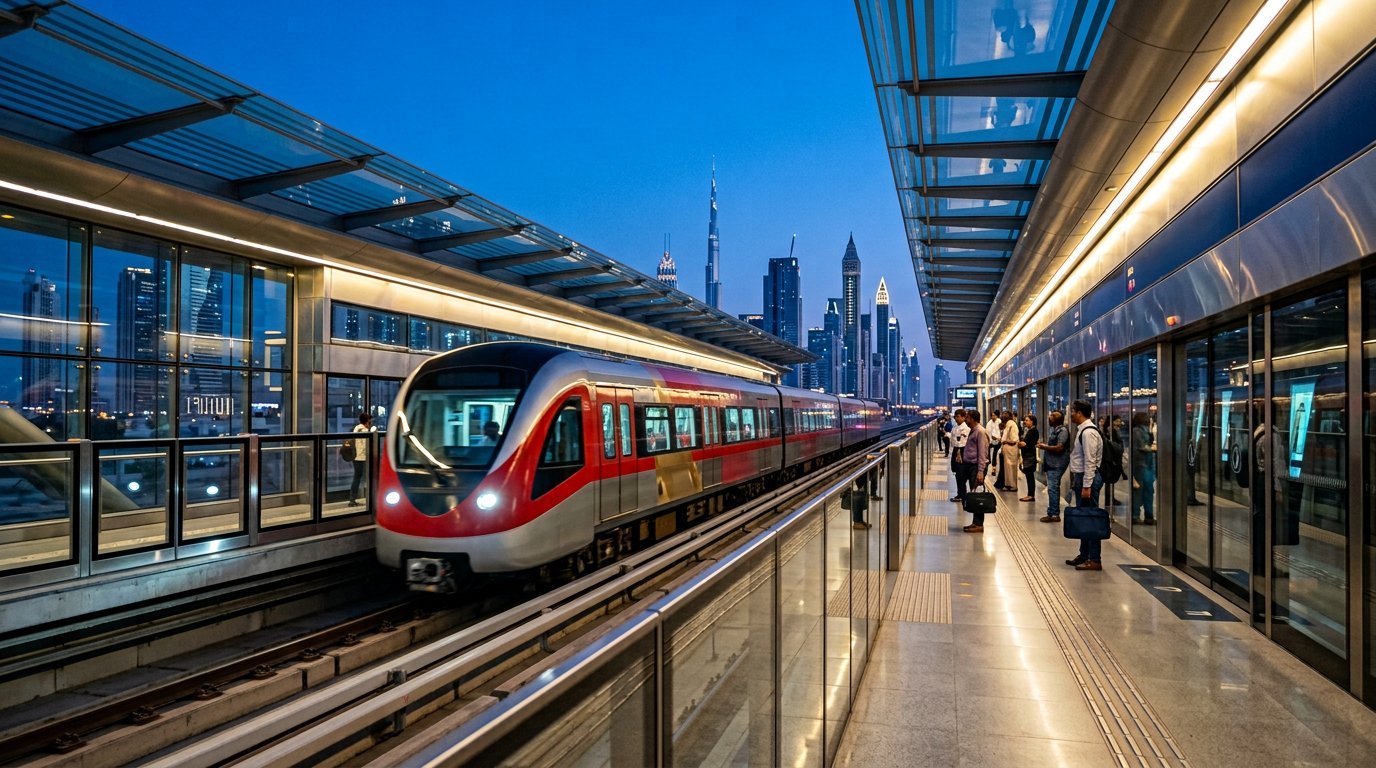
Dubai Metro runs two lines — the Red Line and the Green Line — with fares from AED 3 to AED 7.50 on a Silver Nol card, depending on how many zones you cross. Trains operate from 5:00 AM to midnight Monday to Thursday and Saturday, until 1:00 AM on Friday, and from 8:00 AM on Sunday.
This guide pulls together everything a resident or visitor actually needs: the zone system, every Nol card type and what it costs, daily fare caps, transfer rules, and the practical details that catch people out at the gate.
Dubai Metro at a Glance
| Detail | Information |
|---|---|
| Lines | Red Line and Green Line |
| Operator | Roads and Transport Authority (RTA) |
| Operating hours | 5:00 AM – 12:00 AM (Mon–Thu, Sat) |
| Friday | 5:00 AM – 1:00 AM |
| Sunday | 8:00 AM – 12:00 AM |
| Payment | Nol card or Nol Red Ticket — cash is not accepted |
| Standard fare | AED 3 – AED 7.50 (Silver Nol) |
| Interchange stations | Union and BurJuman |
How Dubai Metro Fares Work
Dubai uses a zone-based fare system rather than charging per station or per kilometre. What you pay depends on how many fare zones your journey crosses, not how long you sit on the train. A short hop that happens to cross a zone boundary can cost more than a longer ride that stays inside one zone.
You tap in at the gate when you enter and tap out when you leave. The system calculates zones automatically. Forgetting to tap out is the single most common and most expensive mistake — you will be charged the maximum fare for that journey.
Fares by Nol card type
| Journey | Silver Nol | Gold Nol | Blue (Personal) | Red Ticket |
|---|---|---|---|---|
| Within 1 zone | AED 3.00 | AED 6.00 | AED 3.00 | AED 4.00 |
| 2 adjacent zones | AED 5.00 | AED 10.00 | AED 5.00 | AED 6.00 |
| More than 2 zones | AED 7.50 | AED 15.00 | AED 7.50 | AED 8.50 |
Gold Class costs exactly double the standard fare and buys you a separate cabin at the front of the train with wider seats and far fewer people. Whether that is worth double depends entirely on whether you are travelling at 8:00 AM or 2:00 PM.
Nol Cards Explained
You cannot pay cash on the Dubai Metro. Every passenger needs a Nol card or a paper Red Ticket, and the right choice depends almost entirely on how long you are staying.
| Card | Price | Includes | Best for |
|---|---|---|---|
| Nol Silver | AED 25 | AED 19 travel credit | Most residents and visitors |
| Nol Gold | AED 25 | AED 19 travel credit | Gold Class cabin access |
| Nol Blue (Personal) | AED 70 | AED 20 travel credit | Registered residents, concessions |
| Nol Red Ticket | AED 2 | No credit — load per trip | One-off or short visits |
Card prices above are taken from the official RTA Nol page. The Silver card is the sensible default: it works on the metro, buses, tram, water bus and even RTA parking meters.
Who qualifies for discounted travel
The Nol Blue is a personalised card and the only route to concession fares. Students, senior Emiratis and People of Determination can apply with supporting documents at an RTA customer service centre. It costs more up front (AED 70) but pays for itself quickly if you qualify.
Red Line vs Green Line
The Red Line is the long spine of the network. It runs from Centrepoint in the north-east, along Sheikh Zayed Road past Burj Khalifa and Dubai Marina, and splits near Jebel Ali — one branch heading to Expo City, the other to UAE Exchange. It serves both Dubai International Airport terminals.
The Green Line covers older, denser Dubai: Deira, Al Fahidi, the Gold Souk, Al Jadaf and Dubai Creek. It is shorter but passes through the parts of the city most visitors actually want to walk around.
The two lines meet at Union and BurJuman. Both are busy interchanges — allow a few extra minutes to change platforms at peak times.
For station-level detail, see our guides to Expo Metro Station, Al Rigga Metro Station, Baniyas Square Metro Station, DMCC Metro Station, Internet City Metro Station and DAFZA Metro Station.
Transfers and the 30-Minute Rule
Dubai’s transport network is integrated, which is worth understanding because it saves real money. If you switch between metro, tram and bus within 30 minutes of tapping out, RTA treats the whole thing as one continuous journey and charges you a single fare based on total zones crossed.
Step outside that 30-minute window and the next tap starts a brand-new journey at a brand-new fare. A long coffee break at an interchange is usually what breaks it.
Park and Ride
Several terminal and outer stations offer Park and Ride facilities, which are free for metro users. This is the standard commuting pattern for people living in outer communities — drive to the station, park, and take the train into the centre rather than fighting Sheikh Zayed Road traffic and paying for city parking.
Practical Tips That Actually Save Money
- Always tap out. Forgetting costs you the maximum fare, every time.
- Top up online through the RTA app instead of queuing at station machines.
- Consider a monthly pass if you commute daily — it works out cheaper than paying per journey.
- Avoid 7:00–9:00 AM and 5:30–7:30 PM if you can. Peak trains on the Red Line are genuinely packed.
- Keep a minimum balance. Gates will not let you start a journey without sufficient credit.
- Use the women and children cabin if it suits you — it is usually far less crowded than standard class.
Accessibility
Every Dubai Metro station is step-free. Lifts, tactile guidance paths for visually impaired passengers, dedicated wheelchair spaces on trains and priority seating are standard across the network. People of Determination travel free with the appropriate Nol card.
Note: Fares, timings and card prices change. Before a trip that depends on exact figures, check the RTA website or the RTA app for live information.
Monthly and Weekly Passes
If you commute daily, per-journey fares stop making sense quickly. RTA offers period passes covering unlimited travel on metro, tram, bus and water bus.
Passes are priced by zone coverage — a single-zone pass if you live and work in the same zone, or an all-zones pass for maximum flexibility. Concession holders with a Nol Blue card pay substantially less. Check current pricing on the RTA website before buying, as pass pricing is revised periodically.
The rough rule: if you make more than about two return journeys per working day, or you travel across multiple zones daily, a monthly pass beats pay-as-you-go.
Luggage and Airport Journeys
The Red Line serves both Terminal 1 and Terminal 3, which makes it the cheapest airport connection in the city by a wide margin. There are limits though: oversized luggage is restricted during peak hours, and there is no dedicated luggage storage on trains.
For one or two cabin bags the metro is ideal. For a family with multiple large suitcases at 8:00 AM, a taxi is the realistic choice.
Etiquette and Rules Worth Knowing
- Eating and drinking are prohibited on trains and in paid areas — fines apply, including for water
- The first cabin is Gold Class and requires a Gold card; sitting there with a Silver card results in a fine
- The women and children cabin is enforced — men entering it face a fine
- Priority seating is for People of Determination, seniors and pregnant women
- No pets except service animals
These are enforced by inspectors, not just posted as suggestions. The fines are meaningful enough to matter.
Where the Network Is Heading
The Dubai Metro continues to expand. The most significant project under way is the Blue Line, which will extend coverage into areas currently served only by bus. See our guide to the Dubai Metro Blue Line for the route, planned stations and expected opening.
For stations beyond the metro network, our UAE public transport guide covers the bus network and intercity connections.
Frequently Asked Questions
How much does the Dubai Metro cost?
With a Silver Nol card, AED 3 for one zone, AED 5 for two adjacent zones and AED 7.50 for more than two zones. Gold Class is double. A paper Red Ticket costs slightly more per journey than a Silver card.
What time does the Dubai Metro start and stop?
Trains run 5:00 AM to midnight Monday to Thursday and Saturday, 5:00 AM to 1:00 AM on Friday, and 8:00 AM to midnight on Sunday. Hours can be extended for major events and holidays.
Can I pay cash on the Dubai Metro?
No. Cash is not accepted anywhere on RTA public transport. You need a Nol card or a Nol Red Ticket, both available from machines and ticket offices at every station.
Which Nol card should I buy?
For most people, the Silver card at AED 25. It includes AED 19 of credit and works across metro, bus, tram, water bus and RTA parking. Buy a Red Ticket only if you are making one or two journeys total.
Does the Dubai Metro go to the airport?
Yes. The Red Line serves both Terminal 1 and Terminal 3 at Dubai International Airport. Note that luggage size limits apply during peak hours.
Is there free Wi-Fi on the Dubai Metro?
Yes, most stations and trains offer free Wi-Fi through the WiFi UAE service, though speeds vary and it is best suited to messaging and light browsing.
Can two people share one Nol card?
No. Each passenger needs their own card or ticket to pass through the fare gates.
Figures verified against official sources in August 2026. UAE fees and rules change often — always confirm the current amount with the relevant authority before you pay or travel.