
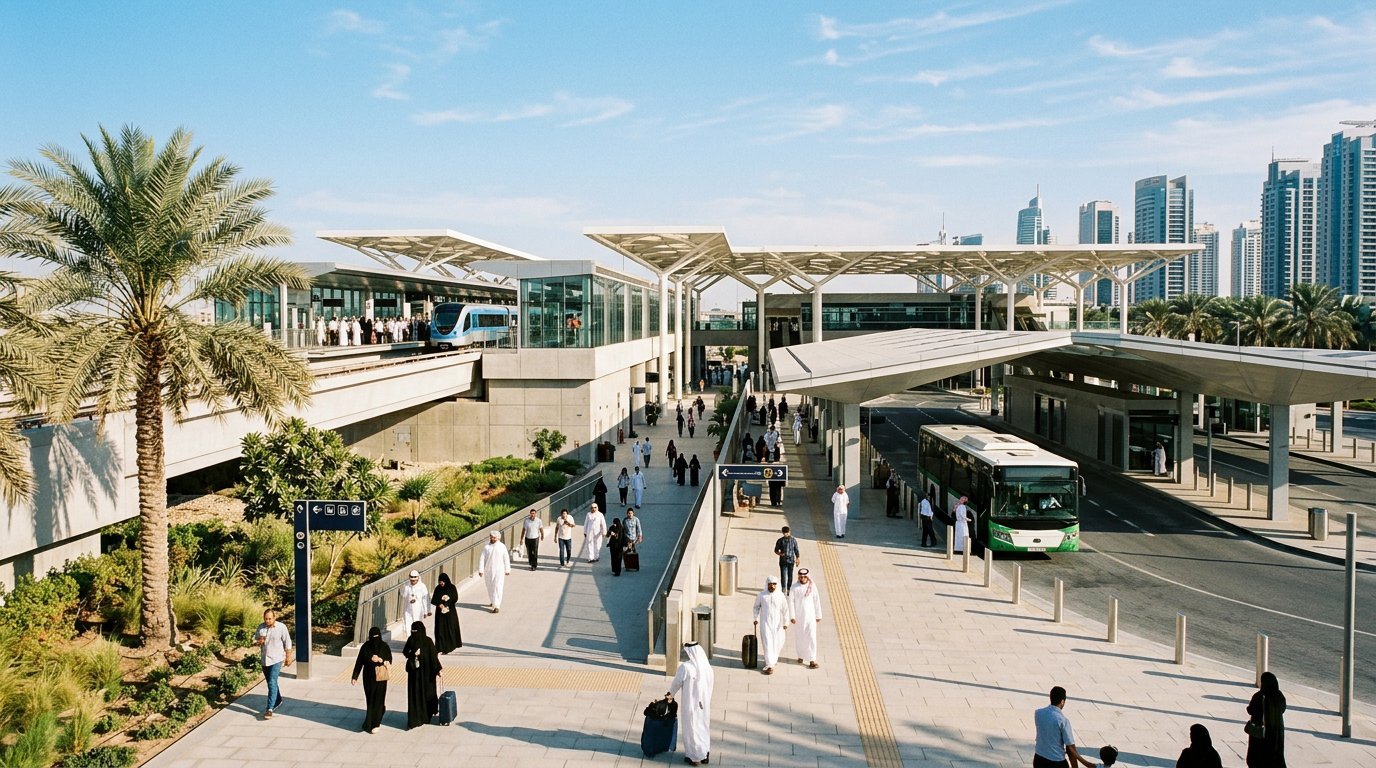
Getting around the UAE without a car is entirely practical in Dubai, workable in Sharjah and Abu Dhabi, and harder in the northern emirates. Dubai’s integrated Nol system covers metro, tram, bus and water transport, while intercity buses connect all seven emirates for AED 10 to AED 30.
This guide covers what each option costs, where it works well, and how to move between emirates without hiring a car.
Transport Options Compared
| Mode | Typical cost | Best for |
|---|---|---|
| Dubai Metro | AED 3–7.50 | Along the Red and Green Line corridors |
| Dubai Tram | AED 3–7.50 | Marina, JBR, Al Sufouh |
| City buses | AED 3–7.50 | Areas the metro does not reach |
| Intercity buses | AED 10–30 | Travel between emirates |
| Taxis | AED 12 base plus meter | Door to door, late nights |
| Ride-hailing | Varies with demand | Convenience, airport runs |
Dubai: The Easiest Emirate Without a Car
Dubai has by far the most developed public transport in the country. The metro is the backbone, with buses filling the gaps and the tram serving the Marina area.
Everything runs on the Nol card, and the integration is the important part: transfer between metro, tram and bus within 30 minutes and you are charged one fare for the whole journey rather than one per leg.
For fares, card types and timings, see our full Dubai Metro guide.
Travelling Between Emirates
Intercity buses are the cheapest way to move between emirates and run frequently on the main corridors. Key routes and terminals:
- Al Jubail Bus Terminal, Sharjah — the main hub for Sharjah departures
- Jubail to Abu Dhabi — roughly 2.5 to 3 hours depending on traffic
- Mussafah Bus Station — a major Abu Dhabi interchange
- Deira City Centre Bus Station — Dubai departures to the northern emirates
- Ibn Battuta Bus Station — serves the Jebel Ali and Abu Dhabi direction
- Fujairah Bus Station — the east coast connection
Journey times are heavily traffic-dependent. The Dubai to Sharjah corridor in particular can double during peak hours — plan around it rather than through it.
Taxis and Ride-Hailing
Taxis are metered, regulated and widely available. In Dubai the starting fare is around AED 12 during the day, higher at night and from the airport. Ride-hailing apps operate across the country with surge pricing at busy times.
For a single traveller commuting daily, taxis are the most expensive realistic option. For a family making an occasional cross-city trip, they are often cheaper than the equivalent in individual bus fares once you count four or five people.
Abu Dhabi
Abu Dhabi has no metro. The bus network is extensive and inexpensive, using the Hafilat card rather than Nol — the two systems are not interchangeable, which surprises people moving between the emirates.
Distances in Abu Dhabi are longer and more spread out than in central Dubai, so many residents find a car more necessary here.
Sharjah and the Northern Emirates
Sharjah runs its own bus network and is well connected to Dubai by intercity services, which is why so many people live in Sharjah and work in Dubai. Within Sharjah, buses cover the main areas but service frequency drops away from the centre.
Ajman, Umm Al Quwain, Ras Al Khaimah and Fujairah have more limited networks. Intercity buses connect them to the larger emirates, but local travel typically means taxis or a car.
Choosing Where to Live Around Transport
This is the decision that determines whether you need a car, and it is worth thinking about before signing a tenancy contract:
- Living within walking distance of a metro station in Dubai makes car-free living genuinely comfortable
- Living in Sharjah and working in Dubai saves substantially on rent but costs you time in traffic every day
- Living in Abu Dhabi generally means a car unless you are central and work centrally
- Park and Ride at outer metro stations is a middle path — drive to the station, train into the centre
Car ownership runs roughly AED 1,500–3,000 a month once petrol, Salik tolls, parking, insurance and servicing are counted. See our Dubai cost of living guide for the full picture.
Practical Tips
- Get a Nol card on arrival — it works across metro, tram, bus, water bus and parking
- Remember Nol and Hafilat are separate systems for Dubai and Abu Dhabi
- Always tap out on the metro or you are charged the maximum fare
- Check intercity bus timetables in advance — frequency drops sharply in the evening
- Friday afternoons and Sunday mornings are the worst times on the Dubai–Sharjah road
Salik: Dubai’s Road Toll System
If you do drive in Dubai, Salik toll gates deduct automatically each time you pass. Charges apply per gate crossed, and a commute crossing several gates twice daily adds a meaningful monthly cost.
This is one of the hidden expenses that tips the calculation towards public transport for many commuters. Factor it in alongside petrol, parking and insurance rather than treating it as incidental.
Airport Connections
- Dubai International (DXB) — directly on the Red Line at Terminals 1 and 3; by far the cheapest option
- Al Maktoum International (DWC) — bus connections; the metro extension serves the Expo City area nearby
- Abu Dhabi (AUH) — regular bus services into the city
- Sharjah (SHJ) — buses and taxis, no rail connection
Airport taxis carry a surcharge over the standard starting fare. For solo travellers with light luggage, the metro to DXB is a fraction of the cost.
Accessibility Across the Network
Dubai Metro is fully step-free with lifts, tactile paths and dedicated wheelchair spaces at every station. Buses across the main emirates increasingly offer low-floor access. People of Determination travel free on Dubai’s network with the appropriate Nol card.
Planning Your Journey
The RTA app covers Dubai comprehensively with live timings and route planning. Mainstream mapping apps handle metro and major bus routes well but are less reliable for intercity services, where checking the operator’s timetable directly is safer.
For station-specific detail, browse our guides to individual Dubai Metro stations and bus terminals across the emirates.
Frequently Asked Questions
Can you live in Dubai without a car?
Yes, comfortably, if you live near a metro station and work along the Red or Green Line. The metro, tram and bus network is integrated through the Nol card and covers most of the areas where people live and work.
How much is a bus from Dubai to Abu Dhabi?
Intercity bus fares between emirates typically run AED 10–30 depending on the route. The Dubai to Abu Dhabi journey takes roughly 2 to 2.5 hours in normal traffic.
Can I use a Nol card in Abu Dhabi?
No. Abu Dhabi uses the separate Hafilat card system. Nol works across Dubai’s RTA network only.
What is the cheapest way to travel between emirates?
Intercity buses, at AED 10–30 per journey. They connect all seven emirates and run frequently on the main Dubai, Sharjah and Abu Dhabi corridors.
How much does a taxi cost in Dubai?
The starting fare is around AED 12 during the day, with higher rates at night and for airport pickups, then charged by the metre.
Is public transport in the UAE safe?
Yes. The metro and bus networks are well monitored, clean and considered very safe, including for solo travellers and women. Dedicated women and children cabins are available on the Dubai Metro.
Figures verified against official sources in August 2026. UAE fees and rules change often — always confirm the current amount with the relevant authority before you pay or travel.